Table of Contents
For several years, my job was Product Owner. My priority was to deliver technological solutions, solve bugs - their origin and define solutions for fixing them, prioritize development requirements, monitor the backlog, and solve problems. There are always a lot of them with large solutions. So I had a non-stop job to do. I didn't have to think about anything above me; I just did my job and met the requirements. Then a career change came, and I suddenly found myself in a completely new role. Suddenly, I'm not solving the backlog, but I have the space to look inside myself. When I sat down in a chair this morning and started writing an article on a DIY Tote bag tutorial for beginners, I had to stop. When I deleted the introduction about six times, I felt absolutely terrible. I'm sitting here on a chair, and my head is racing with thoughts of how on earth I should write it. I know I can write it. I can follow all the necessary rules for creating texts and everything around, but I'm actually afraid to write it. So I'm sitting here in the chair and writing. I have tears in my eyes, and I'm crying. Not because I can't sew a bag. I even know that I can sew it very well. But actually, I'm crying because I'm scared.
I'm starting to move into waters that I don't know at all. Today's world of content creators is very fast-paced. Everyone is beautiful and filming videos on Instagram and TikTok, and I don't know where to start. I'm over 40, I have two children, a mortgage, and now I'm standing in waters I don't know at all. It's a terrible feeling. Technically, I'm an experienced senior in web and content creation. (I've done a few large web projects after all for SEPHORA, iSTYLE ect.) So I can't say that I don't know. Technically, I know exactly what to do. It's sometimes an extremely uncomfortable zone for me. Everything is new. Suddenly, I'm taking more pictures of everything because it occurs to me: "This could be useful for someone else." But I still feel fear in the background. I was used to solving technical and process problems up until now. Not my own insecurities. Why do I delete the introduction six times and then cry? What's happening to me? Maybe it's because I'm not delivering the function, but I'm sharing my journey, and that's very new to me. I always spoke, sometimes a little robotically and coldly, only about my work, never about myself and my feelings.
I'm not delivering the function, but I'm sharing my journey.
Sometimes, a new beginning is so scary and rough. Raw and hard, uncompromising. I think a lot of people who are going through a career change experience this feeling of doubt. It's like when you are sitting in a meeting, and suddenly someone shouts in the middle: "What is he doing here? He doesn't understand this at all!" and even though you know what you're talking about and why. Why do these doubts come from the back of my mind? I'm sitting here, writing and thinking. I told myself that I'm going to deliberately not delete what I write for 15 minutes now. I don't want to delete my doubts. I have to put it on paper so that I can see in black and white what's going on in my head and understand why. If I don't put it on paper, my thoughts will fly away like the wind blowing clouds away. All of us who are going through this career/professional change are leaving our comfort zone. Some don't show it and hide it deep inside. Some doubt themselves and decide to face it. Understand that feeling is important because it helps us deal with it and grow. I'm not crying right now, so it's okay, but maybe it will come again. I'm not dealing with the ongoing development sprint, or which features I'll deliver next quarter. I'm dealing with myself. Just the way I am. These are new feelings that I wasn't used to at all. I was going like lightning, and suddenly I had the space to look at the sky and just stand there.
Why does imposter syndrome strike us right after a major life change?
Why do I actually get these strange feelings that I can't quite grasp yet? Maybe I feel that with the loss of my previous job, I also lost my established role as an expert. I suddenly feel a little like a rookie among seasoned experts who are 20 years younger. It's probably natural that, after such a change, the feelings it brings overtake us for a while. We are outside our comfort zone. A new, long way. In the same way as the legendary Sandonoriko was for Atreyu from The Neverending Story. When I worked in corporate, I was simply the one who knew. Here I am at the beginning. On the one hand, I tell myself that I have enough experience to build on. On the other hand, I am aware that I am standing at the starting line at a time when the greasers ran out in front a few years ago. How can I compare myself and surpass people who have more than 1000 days ahead? It is an incredible test for emotions, and it doesn't matter if we are starting our own business or just changing positions on the job market. Every such change that throws us back to the beginning is our huge test. We are suddenly outside our comfort zone. No one cares, and it is difficult for someone to lend us a helping hand in the wild jungle by themselves. If you're experiencing the same feelings as I, you might know that you've been affected by Imposter Syndrome. On the one hand, it's a bummer that you're experiencing huge doubts about your own identity. You feel like an impostor just because you've integrated into a new place where you don't yet know if you belong. You know you enjoy it, it's fulfilling, but your self-confidence is completely uncompromising, and you're kicking yourself like I'm now, deleting the introduction to the article on how to sew a tote bag for the sixth time. It's psycho.
How do you know that you are controlled by Impostor Syndrome?
I am thinking about what I am writing here. Sometimes, I wake up at night and ask myself, what now? What if something doesn't work out for me? One doesn't have to think it is bad at all... or what if something works out on the contrary? What if my article pops up in a better position in the browser? Is it just a coincidence, or is it really the result of my work? I try not to get into trouble... Do you also sometimes ask yourself these questions and doubt yourself? I think it is part of the process of change. It seems a bit like a natural side effect to me. Like when you take medication that also has side effects. Some people get them, and some don't. But what about those who do? How should we deal with it? We have gone to the market with our skin. We have entered a completely new arena, and we are learning new rules as the game goes on. What to do with it now, and how to deal with this syndrome?
Strategies for dealing with Imposter Syndrome: How to overcome your doubts?
Identify Transferable skills for a career pivot
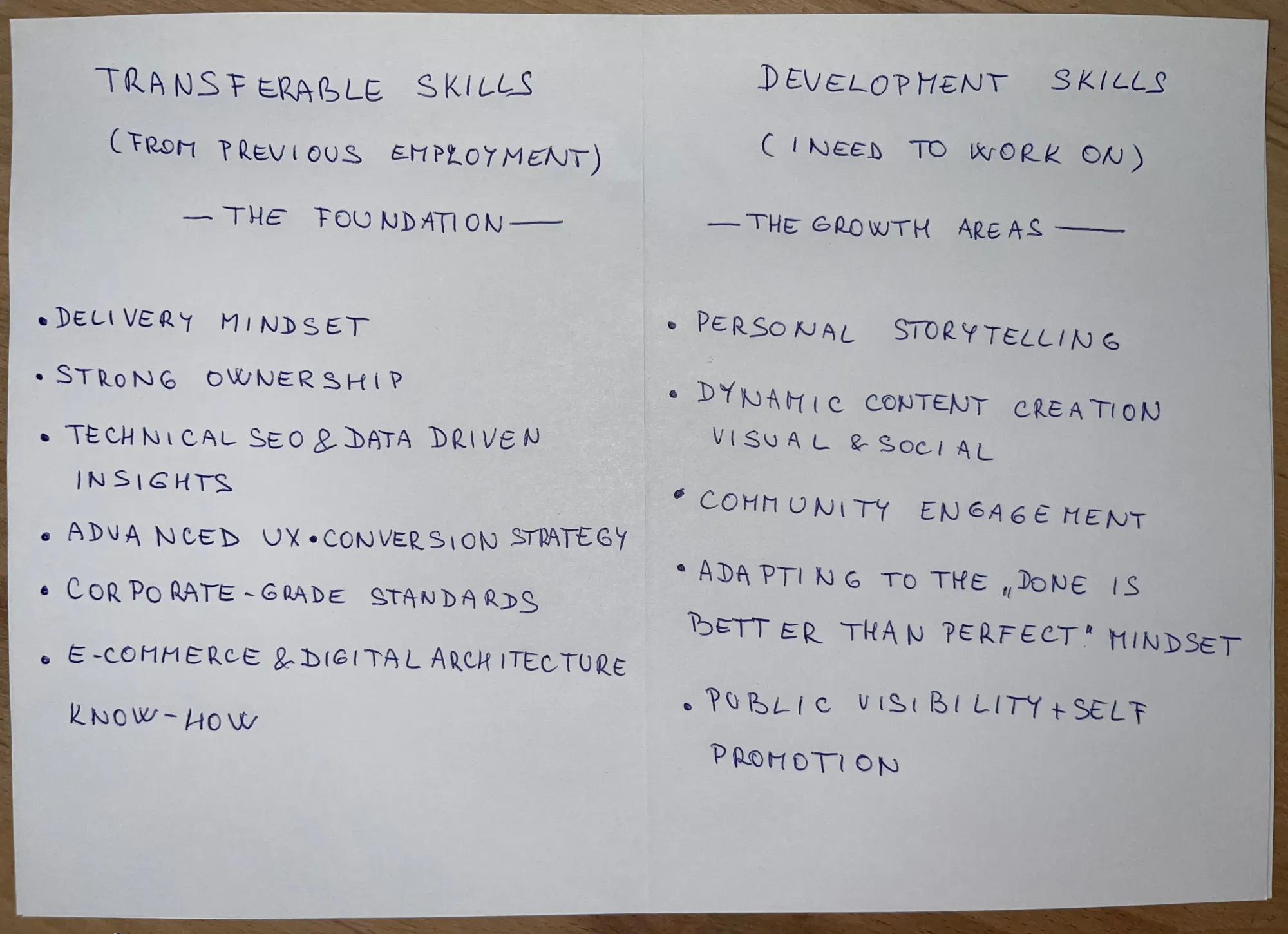
We all have some skills... If you feel like a flood, sit down and write down on paper what your knowledge and skills are. Write it down. You can't just say it. Because the word will immediately disappear. Your brain needs to see your Transferable skills for a career pivot, which it now kind of denies, making you a zero even though you are not. You are no longer starting from zero. You are just afraid, like me, of the new and the unknown. In my opinion, this is a natural part of human development. It is never bad forever. Accept it as a beginning. You know this and that, and you still have to learn more. I also had to learn how to edit a video on my phone and finish editing one in YouTube Studio. It is a lot of new things for me too. It also helped me a lot to realize that hundreds of thousands of people on the planet experience similar feelings. Did you know that Imposter Syndrome has a monthly global search volume of 200,000-300,000? So we are not alone. That reassures me a little. I am not the only one who starts out in unfamiliar waters after a career change.

Accept the role of "apprentice"
It is also true that I immediately feel better when I accept the role of "apprentice". It is just the way it is. I am new and learning things I have not had to deal with before. It is a natural part of the career transition process. If I lie to myself that I am great at everything, I will only be lying to myself. I want to live honestly and not lie to myself or others. I would rather admit that I have to learn something new than to chase after fools and lie to myself and others. If we have a big career change, it is natural that with a new position comes new challenges. We constantly have to learn new things. Life is actually a constant cycle of new things, so why make a science out of it, right? It is simply a natural part of change. If you are surprised by a question at your new job, feel free to answer: "That's a great question, I'll find out and let you know." Or "Thats a great question, We will prepare this report for next meeting to discuss this topic deeply."
Separate emotions from skills
The fact that I sometimes feel like a fraud because I suddenly do something completely new to me does not mean I am a fraud. I am simply new to the field, and I just have to admit it because I was an expert in another field for a long time.
I found somewhere that I should also write down the successes that surprised me, so that I can see them in black and white and stop doubting myself sometimes.
Find the best book for you
There are also various books that talk about this syndrome and teach how to deal with it.
The Imposter Cure From Author Dr. Jessamy Hibberd
Jessamy Hibberd is a renowned British psychologist. The book strikes me as a bare minimum if you are looking for mental exercises that will move you forward. The book's introduction shows how you can use exercises to break out of the vicious circle of thoughts like "Any moment they will find out what I am." In addition, you can use this book to follow up on "Separating Emotions from Skills." I would probably start with this at the beginning, because without it it is difficult to move forward.
The Secret Thoughts of Successful Women Author: Dr. Valerie Young is great
For those of us who are making career leaps. The woman who wrote this book is a globally recognized expert on The Imposter Syndrome. In the book, she discusses in quite detail why successful women in corporate settings suffer the most from this syndrome after switching to freelance work. She divides this syndrome into 5 basic archetypes, in which you may very quickly find yourself.
The Gifts of Imperfection Author: Brené Brown
If you need to add courage to show your vulnerability, this book is great. The book resonates a lot with working with fear, with your own courage. When reading this book, you will understand why vulnerability is important and why it is essential to look at potential failure as data that you can analyze to move forward a little bit. Here you will find courage if you need it, but don't think that everything takes time, and reading something is one thing, but adapting it is another, more demanding thing.
The War of Art author: Steven Pressfield
For a little creativity and creation. This book will help you exactly when you are in my place. That is. You write, erase, write, cry, and erase again. In it, the author of the book explains the topic of the inner workings of the brain from the perspective of its resistance to change. Every time we want to change something, our brain starts to set up in the background, which resists any change. Thanks to this book, you will understand what happens to your mind when you are going through a period of change and the author will help you understand that experiencing fear is just proof that you really care about something, but you must not give in to it too much.
Get community help
A friend of mine opened her own fashion clothing store some time ago. It was a big test in her life. When she was in trouble, she sought help from a community of entrepreneurs with the same focus, who shared advice and supported one another. I think communities are great too. I am not in any right now, but I explore new areas deep within myself almost every day. There is a moment of sadness, then my hard-nosed realist core lays the hard facts on the table, and I am instantly at peace. But I am aware that not all of us are like that.
Mindset change: From disadvantage to advantage
I think I'm definitely not done yet; every change takes time, and psychological changes take the longest. But it helps me a lot to realize that, as a newcomer in my field, I see things that others don't see today. I'm new in the field, I see uncovered areas, it's an opportunity for me and not a disadvantage. This fact is of enormous value to me. In addition, I have a huge opportunity to grow. I don't have to look at my own mistakes as personal failures, but as data, the path leads this way, and maybe it doesn't lead that way. It's okay, I'm in new waters. I hold the compass firmly and, drawing on skills I can transfer and apply in a new field, I work with informations and, more recently, with my feelings and emotions. (Which is very new and a bit foreign to me so far. But I tell myself every day that I can do it. I just have to learn new things. It's not a drama, is it?)
I still see the main thing: imposter syndrome is actually a side effect of my personal growth. It's natural to doubt, but we must not let it control us. Sometimes we cry, we are in new waters, where there are new rules of the game, but if we are on that path, it means that we develop and work on our own personality, which is more than okay.
If you have ever had a similar feeling, how did you deal with it? I wrote my skills inventory here. Maybe it will help someone to sit down, rest emotionally, relieve, and put together the facts for a new beginning. The only way out is through a narrow window, and we are not alone.