Table of Contents
Deadstock fabrics and sustainable elegance are increasingly relevant topics in society today. Global fashion houses commission exquisite, custom-made fabrics for their collections. But what happens behind the scenes when a collection wraps up and hundreds of meters of fabric remain? What becomes of those vast quantities of silk, cashmere, wool, or jacquard? Do these haute couture fabrics end up in incinerators, landfills, or even the ocean?
In the past, these luxury materials would sit gathering dust in fashion house warehouses; in worse scenarios, they were sent to incinerators or "vanished" without explanation. They would cease to exist, disappearing as if they had never been there at all.
The reality, however, is that nothing vanishes. Every such disappearance follows a specific path, one that is not always ethical toward the planet that blesses us with its resources.
Until just a few years ago, major global brands dealt with overproduction in precisely the ways described above.
It reminds me a bit of tidying up at home by shoving the mess under the bed or behind the sofa, or locking it away in a closet where it’s out of sight, then praying that guests won't look in those spots. After all, no one wants to reveal the clutter hidden in their closets or under their beds.
That makes it all the more gratifying when select global fashion houses and brands reach a turning point—realizing the old ways are no longer sustainable—and begin to clean out that metaphorical closet, stopping the practice of sweeping things under the bed. They want to clear out their inventory so they can operate sustainably in the long run.
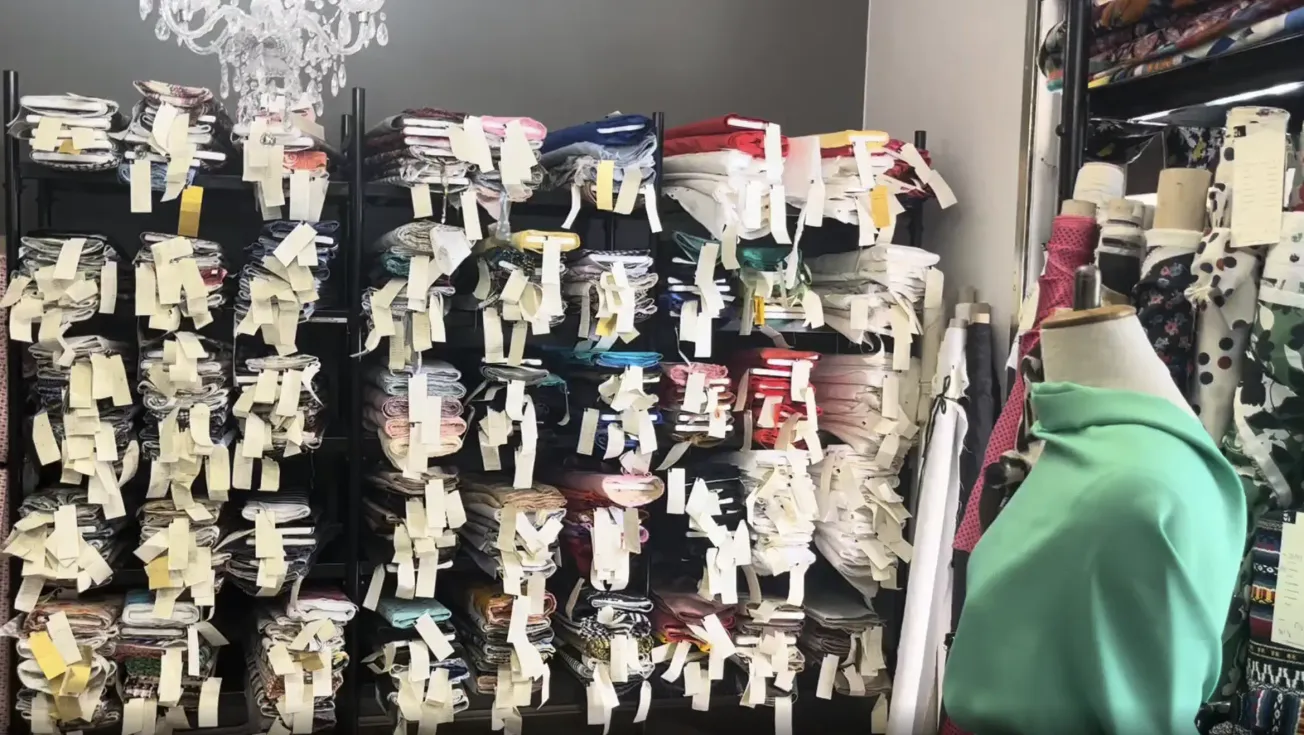
This marks the moment when global fashion houses begin sharing their overstock with the general public; as a result, premium materials reach specialized shops, where independent designers and even ordinary people like us can purchase them.
Some fashion groups are even launching their own online platforms where we can buy these deadstock materials by the meter. It may not seem like much to some, but it is a fantastic move for the fashion industry as a whole.
Because these materials are accessible to everyday people, we can create with beautiful, high-quality, timeless fabrics. At the same time, this poses no threat to fashion houses; independent creators and small-scale designers are not competitors to these global brands but sources of inspiration. Independent creators and home sewists design for real life. Unlike runway concepts made solely for visual impact, we create garments meant to be worn, lived in, and cherished for decades. As a result, the work of these "ordinary," smaller-scale creators can serve as a great source of inspiration for global fashion houses. Many of us create garments that are truly wearable in everyday life. When we invest in a high-end fabric, most of us want to get real use out of the finished piece.
And so, what was once considered "industrial waste" becomes the dream material for someone else.
Today, I’ll show you how to find these materials and how to verify their origins.
Defining and Understanding Designer Deadstock Fabric
I consider this an important topic: aligning on terminology and meanings so that we all understand one another. So what is deadstock fabric?
The concept of "deadstock" has shifted in recent years. It used to refer exclusively to high-end couture fabric remnants from global fashion houses. However, the rise of rampant fast fashion has unfortunately led the term to encompass surplus stock from fast fashion and mass-market brands as well. Let’s break this down so we can better navigate this landscape.
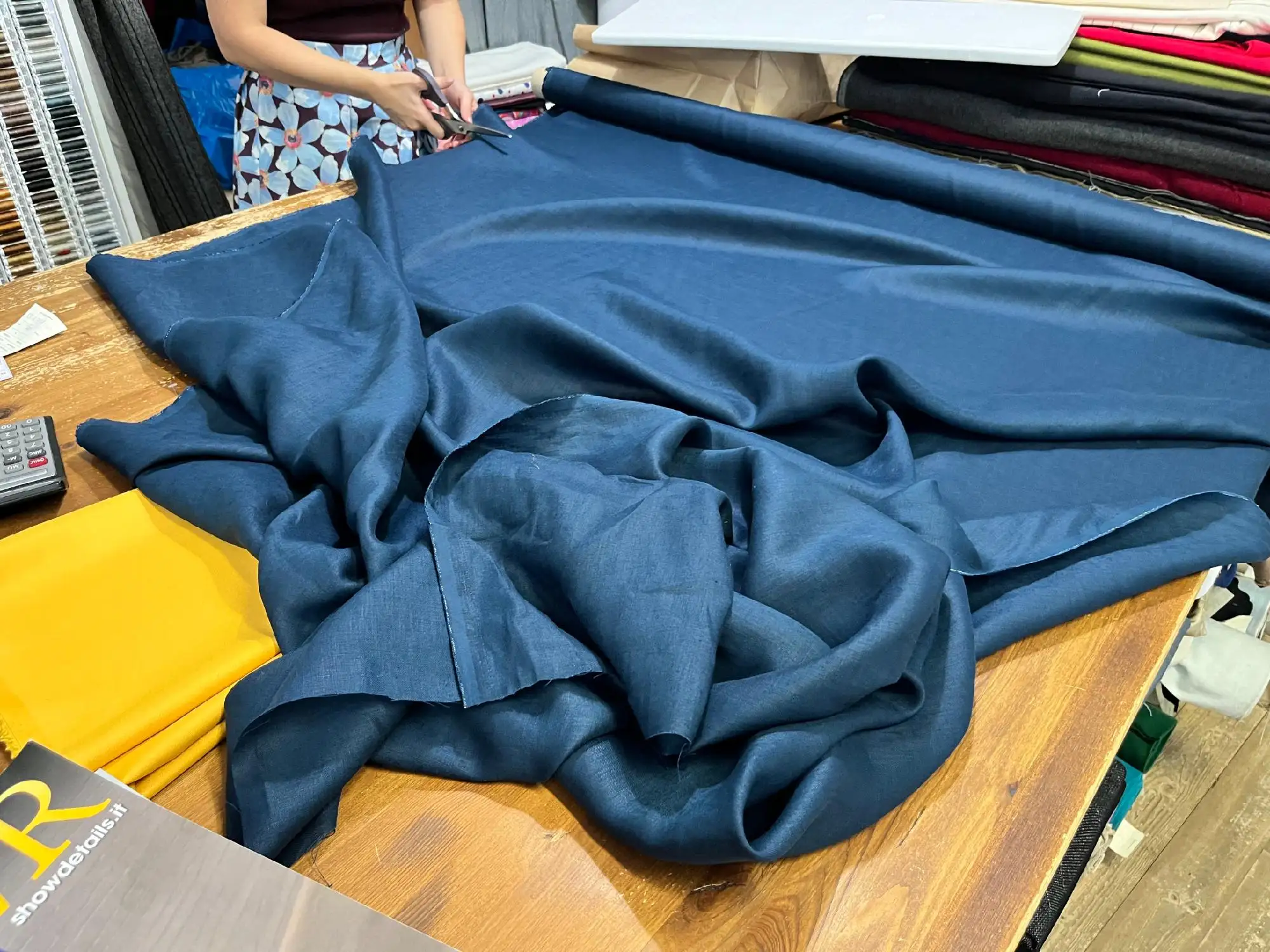
Standard Ready-to-Wear Deadstock (Fast Fashion / Mass Market):
Fabric Origin: Inexpensive surplus materials from large-scale production by mainstream commercial chains—the kind found in shopping malls—or from Asian textile mills.
Material: Predominantly synthetic (polyester or acrylic), sometimes blended with cotton or low-quality cotton. These synthetic fabrics are marketed as "deadstock" because it sounds more appealing; it gives the average online shopper the impression that they are buying a high-end fashion piece at an incredibly low price. "Deadstock" is a broad term that can cover a wide range of products, from fabrics made at top-tier Italian mills to those from Asian mills where workers sleep under their sewing machines to save on the commute and earn more for their families, often enduring inhumane working conditions. Producing these synthetic fabrics prioritizes keeping costs as low as possible; the goal is cheap manufacturing that allows a profit margin even when the final retail price is low. Such fabrics often shrink, pill, and lose their shape. Sometimes, you can even see the grain running crookedly while the fabric is still on the roll; as a result, a T-shirt or dress made from it will twist to the side after washing. Most of us have experienced this with certain garments.
Possible reasons why the fabric wasn't used: it failed basic colorfastness tests for the intended garment, wasn't produced in time, or the required quantity was miscalculated.
Buying deadstock is only sustainable if the fabric already existed without the intention of being sold as waste. If a mill intentionally overproduces polyester or low-quality cotton just to slap an "eco" deadstock label on it, then, in my view, it isn’t circular fashion; it’s just greenwashed fast fashion.
True Couture Deadstock (Haute Couture & Luxury Maisons):
Fabric origins: these are the genuine fabrics most of us envision when we hear the term "deadstock." They are strictly limited, rare, and exceptional pieces from fashion houses in Paris, Milan, and other global fashion capitals (e.g., Dior, Chanel, Louis Vuitton, Bottega Veneta, Loro Piana). Prestigious manufacturers make these materials, such as silk from Lyon, wool from Biella (Italy), and lace from Calais. They often represent small surplus quantities.
Material: always top-tier, very often 100% natural. Occasionally, they add a small amount of synthetic fiber for elasticity and improved shape retention (e.g., up to 5% Lycra). You can always identify these materials by their composition: mulberry silk, wool, cashmere, mohair, intricate jacquard or cloqué, hand-woven tweeds, and more. These fabrics feel different to the touch, not just because of the price, but mainly because of the materials and their composition.
Possible reason why the fabric wasn't used: How is it possible that these fabrics are available at all? Haute couture houses and global fashion brands commission fabrics tailored precisely to their planned collections, specifying color, material, weave type, and so on. The practice involves producing more fabric than is strictly required for the manufacturing process itself. Figuratively speaking, it is like buying eggs for a cake and buying a few extra in case one accidentally breaks into the batter. As a result, weaving mills always produce a surplus of about 10–15%. Once the collection launches, these leftover fabrics are no longer used; naturally, a fashion house cannot reuse the same pattern and fabric type in a new collection when the remaining stock from the previous one consists only of small quantities.
Deadstock fabric Greenwashing: the dark side of a noble trend
The idea of utilizing surplus stock by releasing it onto the open market had truly noble origins. It was a beautiful, eco-conscious trend that fostered a better approach to both fashion and the planet. Unfortunately, what happens when someone discovers something works? Dollar signs start flashing in people's eyes; after all, we live in a consumerist society, and ideas emerge on how to squeeze more profit out of this noble concept.
And thus, "Deadstock Greenwashing" was born: the dark side of a noble trend.
When certain factories realized fabrics labeled "deadstock" sold easily and profitably on the open market, appealing to every woman's desire to own something beautiful, they began intentionally overproducing. They release this excess stock onto the market with the "deadstock" label, capitalizing on the perception that it is ethical and eco-friendly; consequently, it sells faster, often at a higher margin.
Instead of merely utilizing a small amount of leftover material, we see a flood of surplus goods bearing a noble label. The term "deadstock greenwashing" applies primarily to lower-cost materials.
In principle, top-tier weaving mills that partner with global fashion houses lack the capacity to churn out such excessive quantities of fabric.
When surplus fabric from these high-end mills does become available, its superior quality ensures it sells readily, even without the "deadstock" label. Independent fashion designers and private studios know that fabrics from these sources, particularly those with natural compositions, are of excellent quality. If there is a surplus of cashmere originally produced for fashion houses like Max Mara, Gucci, Louis Vuitton, The Row, or Loro Piana, it always sells, even without the "deadstock" label, simply because cashmere isn't just brushed polyester.
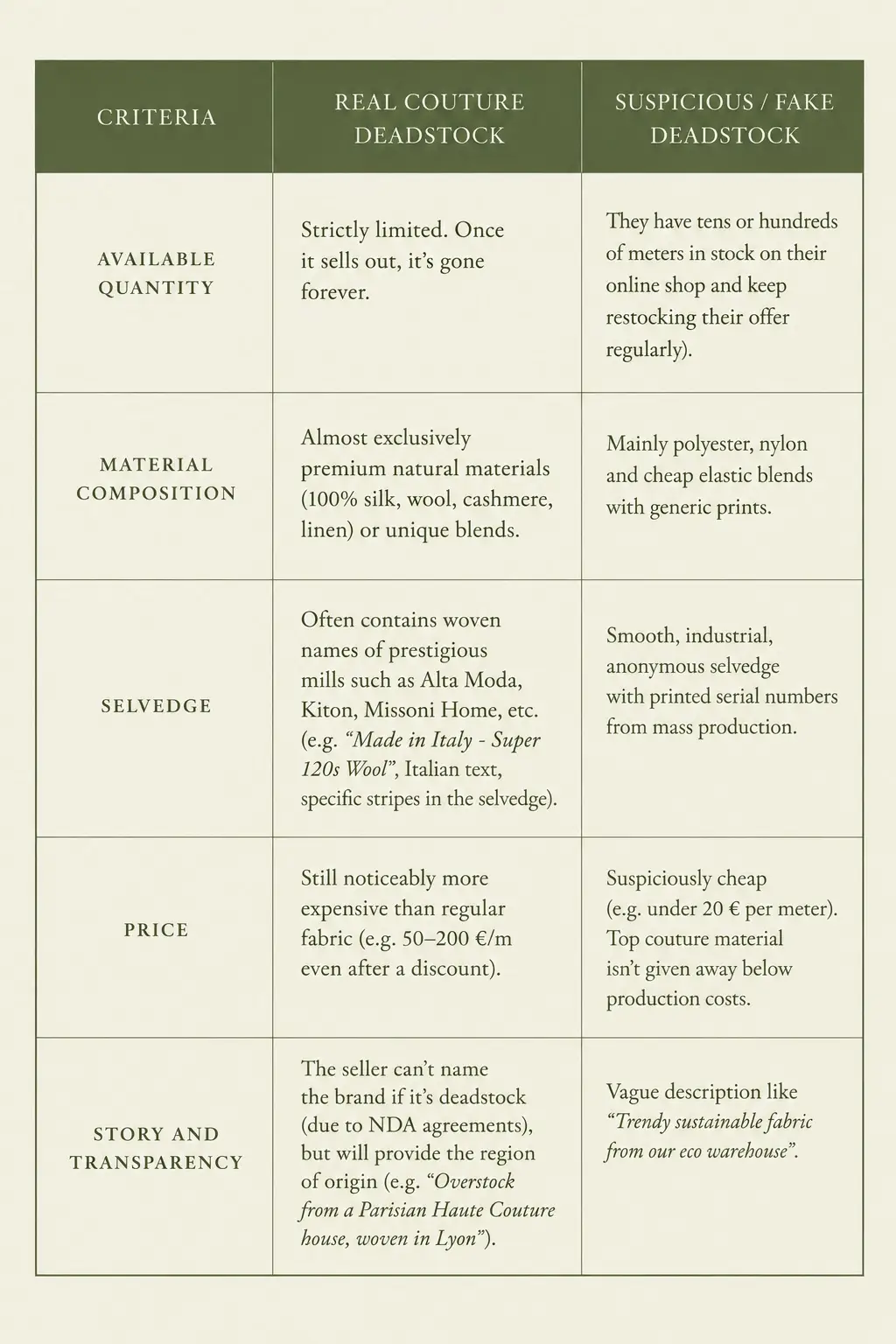
Genuine Deadstock vs. Haute Couture: Spotting the Greenwash
So, how can you distinguish between genuine Couture Deadstock and Ready-to-Wear or "greenwashed" deadstock?
I’ve put together some guidelines to help you navigate your shopping choices.
In select shops, you can find details about the specific fabric, so you can search by brand. However, this information isn't always provided.
Why is the hunt for deadstock so addictive?
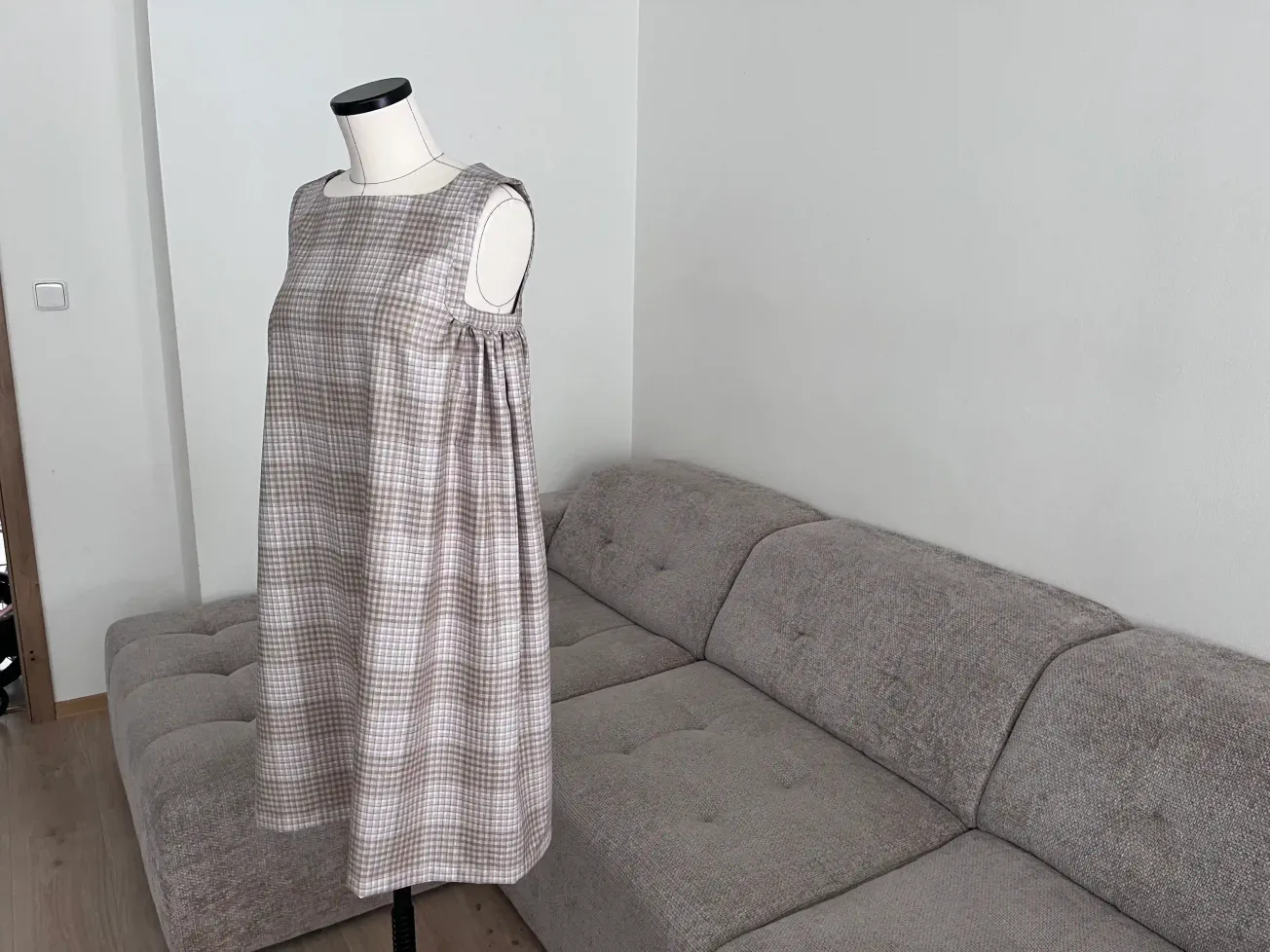
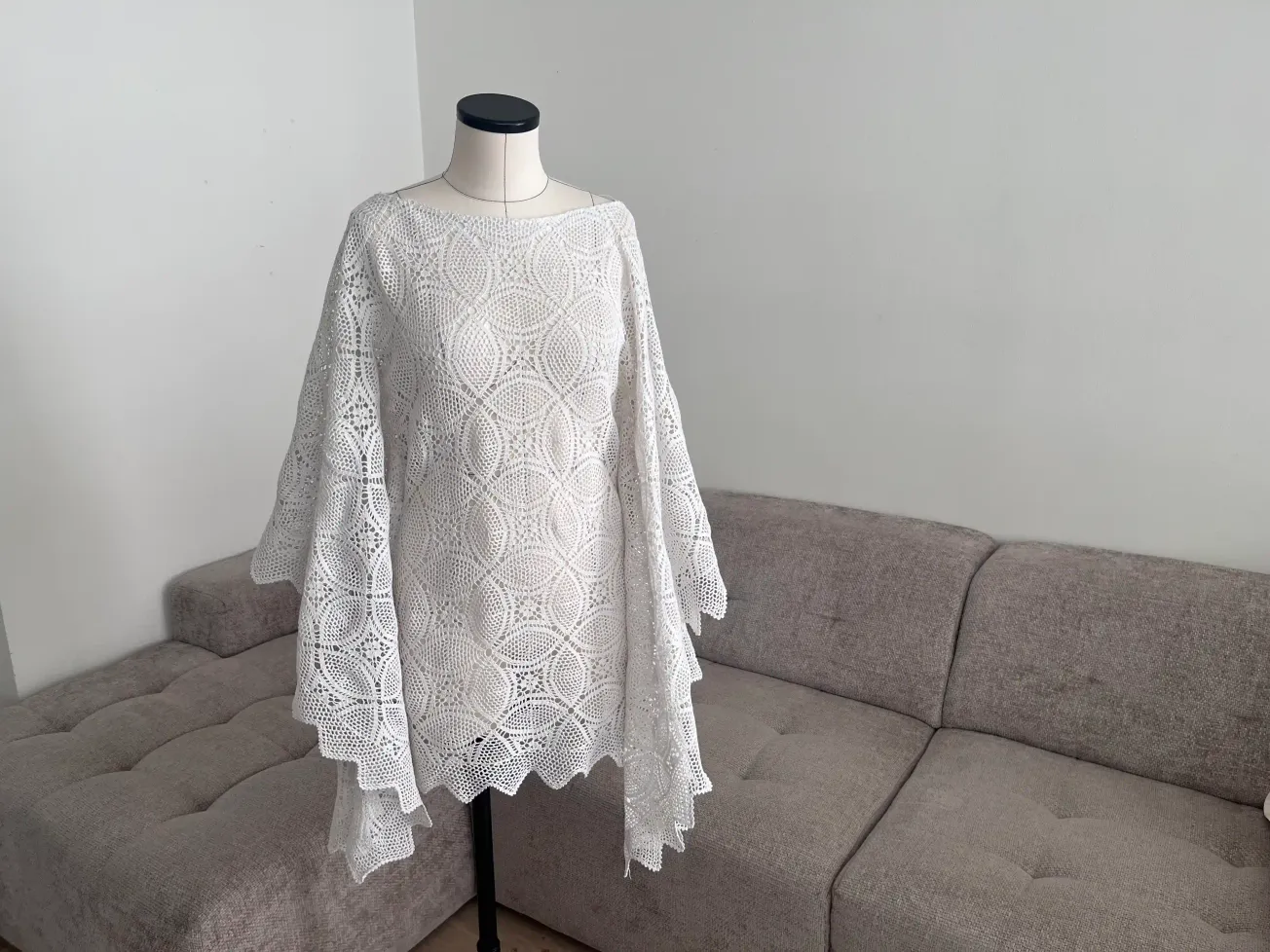
Yes, I use the word "hunt" deliberately. Usually, only small quantities of the fabric are available, so if we don't buy it now, it might be gone by tomorrow. A garment made from designer deadstock fabric is truly one of a kind. I’ve found that I sew much more slowly when working with premium fabrics. I savor the process of creating a garment and embrace the "Quiet Sewing" concept. No one is rushing me; I already have a T-shirt in my closet. Now, I simply enjoy the feel of stunning patterns and materials. I love examining the weave of the threads. I would love to see the production process behind haute couture fabrics someday—holding cloqué, jacquards, or Chanel tweeds in my hands. They are magnificent. I view them as works of art. I recently sewed a dress from Loro Piana linen; when held against the light, you can beautifully see the arrangement of the individual threads. Perceiving that structure is breathtaking. That’s why rushing doesn't pay off. What is the point of ten poorly sewn items? Do you want to examine the fabric? To touch it and look at it closely?
I am working on a special page for you now about where to buy deadstock fabric from fashion houses. It will feature a list of locations and online shops where you can purchase premium, authentic deadstock materials. If you know of any, I’d love for you to share them with the rest of us so we can all make the search easier for one another. Or just reach out to me via the contact form, and I will add this store to the list. We should help each other with slow-fashion fabric sourcing.
Let me know your opinion in the comments.
Dana